





Anyone with polyneuropathy looking for a foot massager will quickly come across rankings featuring ‘test winner’ labels. The problem is that most of these come from comparison websites that rank products based on manufacturers’ specifications and customer reviews, rather than their own testing. And even a thoroughly tested device says nothing about whether it’s suitable for your specific symptoms. This article therefore does not provide a ranking, but rather the criteria you can use to assess devices yourself. For information on what a device can generally achieve for damaged nerves, see the guide ‘Foot massagers for neuropathy’.
Show table of contents
- Next article: Reflexology for neuropathy: what it can and cannot do
- Next article: Who should not use a foot massager? Main contraindications
- Next article: EMS foot massager instructions: how to use it correctly
- Next article: Foot massager for neuropathy: benefits and limits
- Next article: Massager for neuropathy: which type suits damaged nerves?
- Next article: When should you not use a foot massager?
Summary/TLDR
With polyneuropathy, different factors are important compared to a standard wellness device: an adjustable intensity that can be set to a very gentle level, a heat function that can be switched off or strictly limited, an automatic shut-off feature, and controls that can be reached without having to bend down. EMS devices, which work with electrical pulses, are a special case and require prior medical assessment – particularly in cases of diabetes, impaired temperature or pain sensation, pacemakers or open wounds on the foot. A massage device does not treat polyneuropathy. It can help to relieve accompanying tension and abnormal sensations; the underlying cause must be addressed by a doctor.
Why different criteria apply in the case of polyneuropathy
Polyneuropathy alters the way the foot transmits sensory signals. A typical feature is a combination that seems contradictory at first glance: some areas are numb and have reduced sensation, whilst others are hypersensitive to touch. Together, these make the feedback – which you would normally rely on when using a massage device – unreliable.
This has two practical implications. Firstly: you realise too late if a device is pressing too hard or getting too hot – the usual safeguard of ‘that hurts, I’ll stop’ may not apply. Secondly: what is considered pleasantly firm for healthy feet can be far too much in this case.
That is why the most important feature is not the maximum power, but how gentle the lowest setting actually is. Many devices advertise three intensity levels, with even level one applying considerable pressure. For this area of use, that is the wrong design.
The six criteria that really matter
| Criterion | What to look out for | Why |
|---|---|---|
| Lowest intensity setting | Can the device be adjusted to a gentle vibration? | If you have impaired sensation, excessive pressure is the main risk |
| Heat | Can be switched off separately; temperature limited | Numb areas do not reliably signal heat |
| Automatic switch-off | 15 to 20 minutes, no longer | Prevents unnoticed prolonged use |
| Operation | Remote control or foot switch instead of a button on the unit | Bending down whilst seated is impractical and makes the unit wobbly |
| Opening and fit | Does the foot fit inside without getting caught? | Pressure points are a particular concern for people with neuropathy and diabetes |
| Cleaning | Removable, washable inner lining | Hygiene, particularly for sensitive skin |
The order is deliberate: the first three points are safety criteria, whilst the last three relate to everyday use. A device that fails the first three criteria will not be made better by good workmanship.
EMS devices: the special case
EMS foot mats do not work mechanically, but rather using weak electrical pulses that stimulate the muscles to contract. They are often specifically marketed for neuropathy. This warrants a clear explanation.
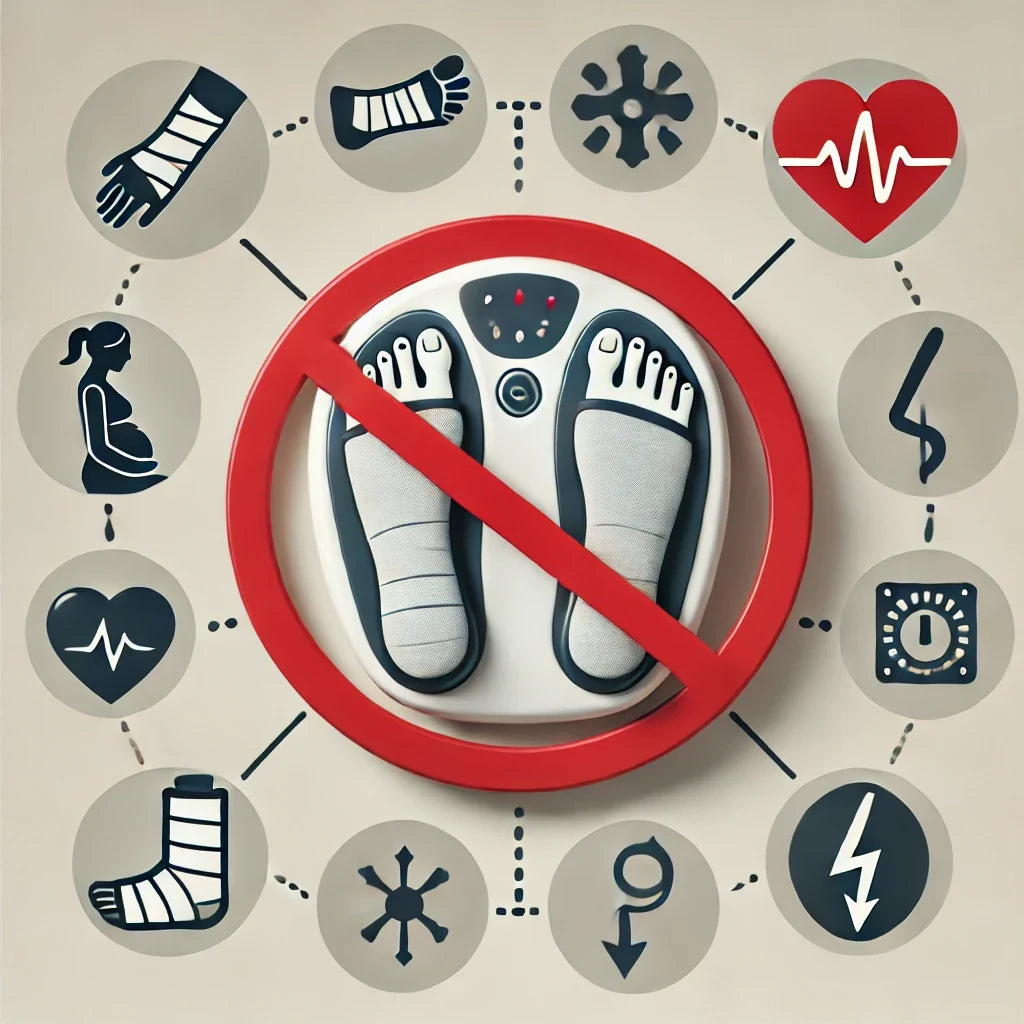
Electrical muscle stimulation is an established procedure, but it does have genuine contraindications. You should seek medical advice beforehand if you have:
- pacemakers, implanted defibrillators or other active implants
- Pregnancy
- Epilepsy
- open wounds, ulcers or inflammation of the foot
- Diabetes with diabetic foot syndrome
- Thrombosis or suspected thrombosis
The last point is particularly relevant in the case of polyneuropathy, as a significant proportion of cases are caused by diabetes. If you are already experiencing skin problems on your feet, using any type of device is the wrong approach – you should see a foot specialist first.
Important safety note: Not suitable for use by people with pacemakers.
What EMS can do in everyday life and how to use it is explained in detail in How to use an EMS foot massager correctly and The benefits of an EMS foot massager. This article discusses whether it can be dangerous.
What lies behind the test winner seals
‘Test winner’ is not a protected term. In this product category, most seals come from comparison websites that analyse data sheets and reviews without actually handling the devices themselves. This isn’t worthless in itself, but it’s not the same as a laboratory test.
If you come across a ‘top pick’ label, check three things:
- Who carried out the test? Is it backed by a testing institute or a comparison site that earns money through affiliate links?
- Was the device physically tested? Phrases such as ‘comparison’ or ‘best-of list’ suggest a desk-based evaluation.
- How old is the test? Product cycles are short; a seal from three years ago may refer to a device that no longer exists in that form.
If a badge cannot answer these three questions, treat it as a marketing label rather than a test result.
What you can safely ignore
Some advertised features sound good, but make little difference in this context:
- Very high kneading intensity. Intended for healthy athletes’ feet, but in this context it’s more of a drawback.
- Lots of automatic programmes. In practice, most people use just two or three settings.
- App connectivity. Convenient, but not a key feature.
- Red light as an extra. Pleasantly warm, but no substitute for treatment.
A simple device is often sufficient for simply promoting blood circulation. This article on blood circulation assesses whether and how well this works.
Water-based devices and bubble baths
Foot whirlpool baths are often mentioned in the same breath as massage devices. In the case of polyneuropathy, there is an additional rule to follow here: check the water temperature with your hand – or, better still, with a thermometer – never with your foot. The very sensation you would rely on in this situation is the one that is impaired. Scalding due to impaired temperature sensation is a well-known problem and can go unnoticed.
Read more about this in Is a foot whirlpool bath dangerous? and, for water-based devices in general, in Foot massager when you have water retention in your legs.
Use: briefly, gently, regularly
With polyneuropathy, the dosage is more important than the device itself. The following approach has proven effective:
- Start on the lowest setting for five minutes, rather than with the programme recommended by the manufacturer
- Check your feet after each session – redness, pressure marks or swelling are signs that you should reduce the intensity
- It’s better to use it for ten minutes daily than for half an hour twice a week
- If tingling, a burning sensation or numbness increases, stop using the device and seek medical advice
For general guidance on how long a session should last, see How long can you use a foot massager?. To find out when you should avoid using one altogether, see When should you not use a foot massager?.
What a device cannot do
A foot massager does not treat polyneuropathy. It has no effect on the damaged nerves and does nothing to address the underlying cause – whether this is due to diabetes, medication, alcohol or other factors. What it can do: it can help to stimulate blood circulation, relax tense foot muscles and, for some people affected, temporarily alleviate the abnormal sensations.
This is a realistic benefit and reason enough to give it a try. However, it is no substitute for identifying the cause or for prescribed treatment. The article ‘Which massage device is suitable for polyneuropathy?’ compares the types of devices that are generally suitable. The manual alternative is foot reflexology for polyneuropathy.
Conclusion
The search for the ‘test winner’ in this category usually leads nowhere, because certification marks are rarely what people are actually looking for. It makes more sense to carry out your own brief test: how gentle is the lowest setting, can the heat be switched off, does the device switch itself off automatically, and can you operate it whilst seated? Anyone who answers these four questions will have done more to inform their decision than any ranking list ever could. And when it comes to EMS: see your doctor first, then make the purchase. The devices themselves are listed in the overview of foot massagers.
Frequently Asked Questions (FAQs)
Which foot massager is best for polyneuropathy?
There is no one-size-fits-all answer to this, as the symptoms vary too widely. The key factors are a very gentle lowest setting, heat that can be switched off, and an automatic shut-off function. A device that meets these three criteria is preferable to a highly rated one that lacks them.
Are EMS foot massagers suitable for neuropathy?
They are marketed for this purpose, but there are genuine contraindications – including pacemakers, pregnancy, epilepsy, open wounds on the foot and diabetic foot syndrome. This question should be discussed with your GP before making a purchase, not on a review site.
Are cheap devices from discount stores any good?
The price says little about suitability. Check the same six criteria as for more expensive models. More important than the brand is whether the intensity can be turned down far enough and whether the heat function can be switched off separately.
How often should the device be used for polyneuropathy?
Short and regular sessions are better than infrequent and prolonged ones. Ten minutes a day on a low setting is a good starting point. After each session, check your feet for redness and pressure marks.
Can a foot massager cure polyneuropathy?
No. It does not act on the damaged nerves and does not address the underlying cause. It can, however, help to stimulate blood circulation and relieve tension. Treatment of the underlying condition should be left to a doctor.
As a diabetic, what do I need to pay particular attention to?
Temperature and pressure points. If you have impaired sensation, you may not notice scalds or chafing until it is too late. If you have diabetic foot syndrome or open sores, you should consult your doctor. In detail: Are foot massagers suitable for people with diabetes?
Which is better: a device with water or without?
For use in cases of polyneuropathy, a dry device is the simpler choice, as there is no need to worry about temperature. If you want a bubble bath, always measure the water temperature with a thermometer, never with your foot.
- Reflexology for neuropathy: what it can and cannot do
- Who should not use a foot massager? Main contraindications
- EMS foot massager instructions: how to use it correctly
- Foot massager for neuropathy: benefits and limits
- Massager for neuropathy: which type suits damaged nerves?
- When should you not use a foot massager?

Written by NAIPO Editorial Team · Massage & Product Experts from Hamburg
Product experts, service technicians, and massage enthusiasts at Alsterwell GmbH — specializing in massage technology for over a decade, with our own workshop and showrooms for test sitting.
Fact-checked by David Eberst · Co-founder of NAIPO


Leave a comment
This site is protected by hCaptcha and the hCaptcha Privacy Policy and Terms of Service apply.